
TD Research Collections
-
All Collections...
-
Topics
-
2. FIND
-
1. UNDERSTAND
-
4. CATCH
-
3. EXPLORE
-
Access Restrictions
-
Subscribers only
-
Premium Collection
-
FREE Resources (Subscribers Only)
-
BONUS "Premium" Collection(s)
-
Premium e-Book
-
Tarpon's Eye Society - Insider's Group
Juvenile Tarpon Science & Biology | UNDERSTAND
Build the foundation. Explore how juvenile tarpon grow, survive and behave, from anatomy and physiology to life stages, feeding, movement and the biological adaptations that shape where they live and how they respond to their environment.
Juvenile Tarpon Habitat & Patterns | FIND
Explore the habitats, environmental conditions, movement patterns and seasonal factors that help determine where juvenile tarpon are found, why they use certain areas and when they are most likely to be active.
Juvenile Tarpon Destinations & Fisheries | EXPLORE
Explore juvenile tarpon fisheries, destinations, regional habitat differences and the local conditions that shape how these fisheries function across the Atlantic and Caribbean. TD covers 9 of the key destinations.
Juvenile Tarpon Fishing & Presentation | CATCH
Explore the presentations, bait, artificials, tackle, positioning and fish-behavior decisions that help anglers turn juvenile tarpon encounters into hookups, while matching each approach to the habitat, forage, conditions and activity level of the fish.
The Tarpon Dreams™
Juvenile Tarpon Intelligence Library
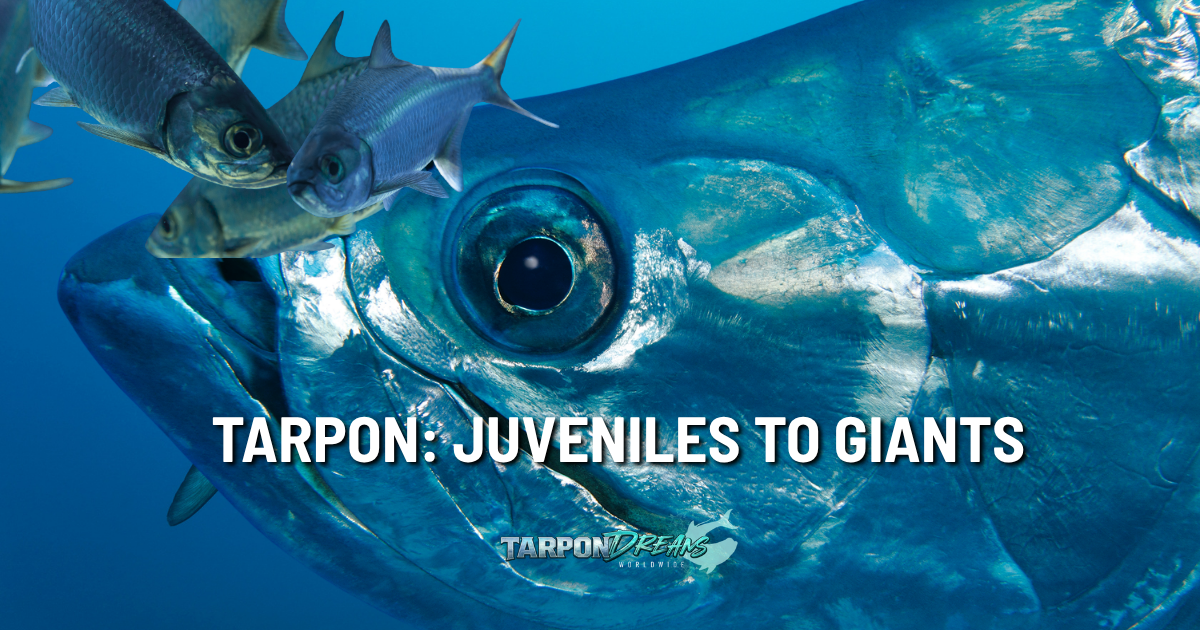
The Juvenile Tarpon Intelligence Library, or JTIL, is being built as a comprehensive resource for anglers who want to understand juvenile tarpon beyond simply knowing where to cast.
Juvenile tarpon are one of the most fascinating inshore gamefish on the planet. They occupy mangrove shorelines, lagoons, canals, creeks, ponds, estuaries and other nursery environments throughout the Atlantic and Caribbean. Some live in places that appear almost too shallow, warm or isolated to support a fish capable of eventually growing into one of the most iconic gamefish in the world.
Yet much of the information anglers encounter about tarpon focuses on the adult fish.
Large migrating tarpon.
Spring and summer tarpon seasons.
Boca Grande.
The Florida Keys.
Beach migrations.
Passes, bridges and coastal spawning movements.
Those fisheries deserve the attention they receive, but they represent only part of the tarpon story.
The Juvenile Tarpon Intelligence Library focuses on...
what happens before those fish become giants.
How do juvenile tarpon develop?
Where do they live?
Why do they choose certain nursery habitats?
What environmental conditions affect their behavior?
Why are juvenile tarpon rolling in one location but seemingly absent from another?
What do they eat?
How do water temperature, salinity, dissolved oxygen, tides, rainfall and seasonal changes influence where they position and when they feed?
And ultimately, how can an angler use that knowledge to make better decisions on the water?
JTIL is being built to explore those questions through a combination of published science, fisheries research, destination intelligence, angler observations and field experience.
The goal is simple:
Understand the fish. Find the fish. Explore where they live. Catch them more intelligently.
UNDERSTAND Juvenile Tarpon
The first part of the Juvenile Tarpon Intelligence Library is UNDERSTAND.
Before we can consistently find or catch juvenile tarpon, it helps to understand what kind of animal we are dealing with.
Tarpon have an unusual life history.
Their earliest development occurs far from many of the protected nursery habitats where anglers eventually encounter them. After the larval stages, young tarpon begin moving into estuaries, backwaters and other nursery environments where they continue developing.
During those juvenile years, they possess biological adaptations that allow them to survive conditions that many other fish struggle to tolerate.
Warm water.
Low dissolved oxygen.
Changing salinity.
Confined nursery environments.
Periodic isolation from larger bodies of water.
One of the most recognizable juvenile tarpon behaviors is rolling at the surface. Anglers often use those rolls to locate fish, but the behavior is also connected to the remarkable physiology that allows tarpon to gulp atmospheric air.
Understanding those adaptations opens the door to much larger questions.
Why do juvenile tarpon thrive in certain habitats?
How does their physiology influence where they live?
What causes them to move?
How does growth affect habitat selection?
What happens as juveniles transition toward larger coastal environments?
The UNDERSTAND collection will examine tarpon biology, early development, nursery ecology, growth, feeding, physiology and the characteristics that make juvenile tarpon uniquely suited to the environments they occupy.
FIND Juvenile Tarpon
Knowing juvenile tarpon exist in an area is very different from knowing where to find them on a particular morning.
The FIND portion of JTIL focuses on the environmental patterns that influence fish location and activity.
Juvenile tarpon may inhabit rivers, creeks, canals, lagoons, mangrove systems, stormwater ponds, estuaries, backcountry basins and other protected waters.
But habitat alone does not guarantee fish.
The better questions are often:
Why are they here?
Why are they here now?
And what conditions make this particular piece of water attractive?
Finding juvenile tarpon requires looking at the entire environment.
Water temperature.
Tide.
Current.
Rainfall.
Salinity.
Water clarity.
Wind.
Dissolved oxygen.
Depth.
Structure.
Forage.
Seasonal movement.
Freshwater influence.
Connection to larger bodies of water.
Some factors may matter greatly in one system and much less in another.
The objective is not to pretend that juvenile tarpon behavior can be reduced to a perfect formula. Fish have a wonderful habit of destroying perfect formulas.
Instead, JTIL is designed to identify recurring patterns that can improve decision-making.
A better understanding of those patterns can help an angler decide which water to investigate, where to begin looking and when conditions may increase the odds of encountering active fish.
That does not eliminate the mystery.
It simply improves the quality of the search.
EXPLORE Juvenile Tarpon Fisheries
Juvenile tarpon are not confined to one famous fishery.
They occur throughout portions of Florida, Puerto Rico, Mexico, Belize, the Bahamas, Central America, the Caribbean and other parts of the species' Atlantic range.
Each location presents a different version of the juvenile tarpon story.
A mangrove lagoon in Puerto Rico does not behave exactly like a Florida backcountry creek.
A Mexican juvenile tarpon fishery may involve different habitat, forage and seasonal conditions than a Caribbean canal or coastal lagoon.
Even within the same island or region, fisheries can vary dramatically.
That is where EXPLORE comes in.
This portion of the Juvenile Tarpon Intelligence Library examines destinations, regional fisheries, nursery habitats and local environmental differences.
The objective is not simply to create another list of places where tarpon can be caught.
We want to understand why the fishery exists there.
What type of habitat supports the population?
Are the fish resident or seasonal?
What size classes are commonly encountered?
What environmental factors shape the fishery?
What other species share the same water?
How accessible is the destination?
What does the fishing experience actually look like?
Some JTIL destination intelligence will come from published research.
Some will come from guides and local anglers.
Some will come directly from Tarpon Dreams field research.
As the library expands, those observations will help build a broader picture of how juvenile tarpon fisheries function across different environments.
CATCH Juvenile Tarpon
Eventually, the research has to meet the water.
The CATCH portion of JTIL turns juvenile tarpon intelligence into practical fishing decisions.
Juvenile tarpon can be caught with live bait, dead bait, artificial lures and flies.
They can be targeted from boats, kayaks, shorelines, docks and wading situations depending on the fishery.
But successful presentations begin before the cast.
Positioning matters.
Approach matters.
Water depth matters.
Fish behavior matters.
Forage matters.
Casting angle matters.
And perhaps most importantly, recognizing whether the fish you found are actually feeding matters.
A group of juvenile tarpon rolling consistently may look spectacular while refusing almost everything thrown at them.
Another group may suddenly begin feeding aggressively with very little obvious change in conditions.
That unpredictability is part of what makes tarpon fishing endlessly interesting.
JTIL will examine presentations, artificial lures, bait, fly fishing, tackle, positioning, retrieve styles, fish behavior and other practical elements of juvenile tarpon fishing.
But the objective is not simply to produce another collection of lure recommendations.
The deeper goal is to connect the presentation to the environment.
Find the pattern first. Then choose the presentation.
Science, Field Intelligence and the Mystery of the Fish
One of the guiding ideas behind the Juvenile Tarpon Intelligence Library is that good fishing intelligence can come from several places.
Scientific research matters.
Published fisheries studies matter.
Historical data matters.
Experienced guides matter.
Local anglers matter.
And repeated observations on the water matter.
None of those sources should automatically replace the others.
Science can explain biological processes that an angler may observe without fully understanding.
Experienced anglers can identify patterns that may not yet have been extensively studied.
Field observations can generate new questions worth researching.
That interaction is where JTIL becomes most useful.
We are not attempting to remove uncertainty from fishing.
That would be impossible, and frankly it would make fishing considerably less interesting.
Sometimes the tide looks right.
The moon looks right.
The water temperature looks right.
The bait is present.
The fish are rolling.
And they refuse to eat.
Other days everything simply comes alive.
The fish are fired up.
The water erupts.
And for reasons that are not immediately obvious, it becomes one of those fishing days you remember for years.
The mystery of the fish remains.
JTIL is about improving the odds without pretending the mystery has disappeared.
The Juvenile Tarpon E-Book Is Coming
The Juvenile Tarpon Intelligence Library is being built as the research foundation for a much larger body of Tarpon Dreams content, including the upcoming Juvenile Tarpon E-Book.
The e-book will draw from the same intelligence organized throughout JTIL.
Biology.
Spawning and early development.
Nursery habitat.
Juvenile ecology.
Environmental drivers.
Movement.
Destination intelligence.
Fishing techniques.
Field observations.
And the unanswered questions that keep sending us back onto the water.
As research expands, portions of that intelligence will also appear throughout TarponDreams.com in Journal articles, Field Notes, destination guides, videos and additional resources.
The objective is not to publish everything at once.
It is to build the deepest practical body of juvenile tarpon intelligence we can, one question, one fishery and one observation at a time.
If juvenile tarpon are your obsession, you are in the right place.
UNDERSTAND the fish.
FIND the pattern.
EXPLORE the water.
CATCH more intelligently.
Juvenile Tarpon Intelligence Library
Coming Soon from Tarpon Dreams™
Plan Smarter. Fish Better.
REGISTER FOR PRE-NOTIFICATION
FOR THE JUVENILE TARPON E-BOOK
Get on the List and Get Notified before it goes LIVE!
 FISH
FISH TRAVEL
 EXPLORE
 Wear It